




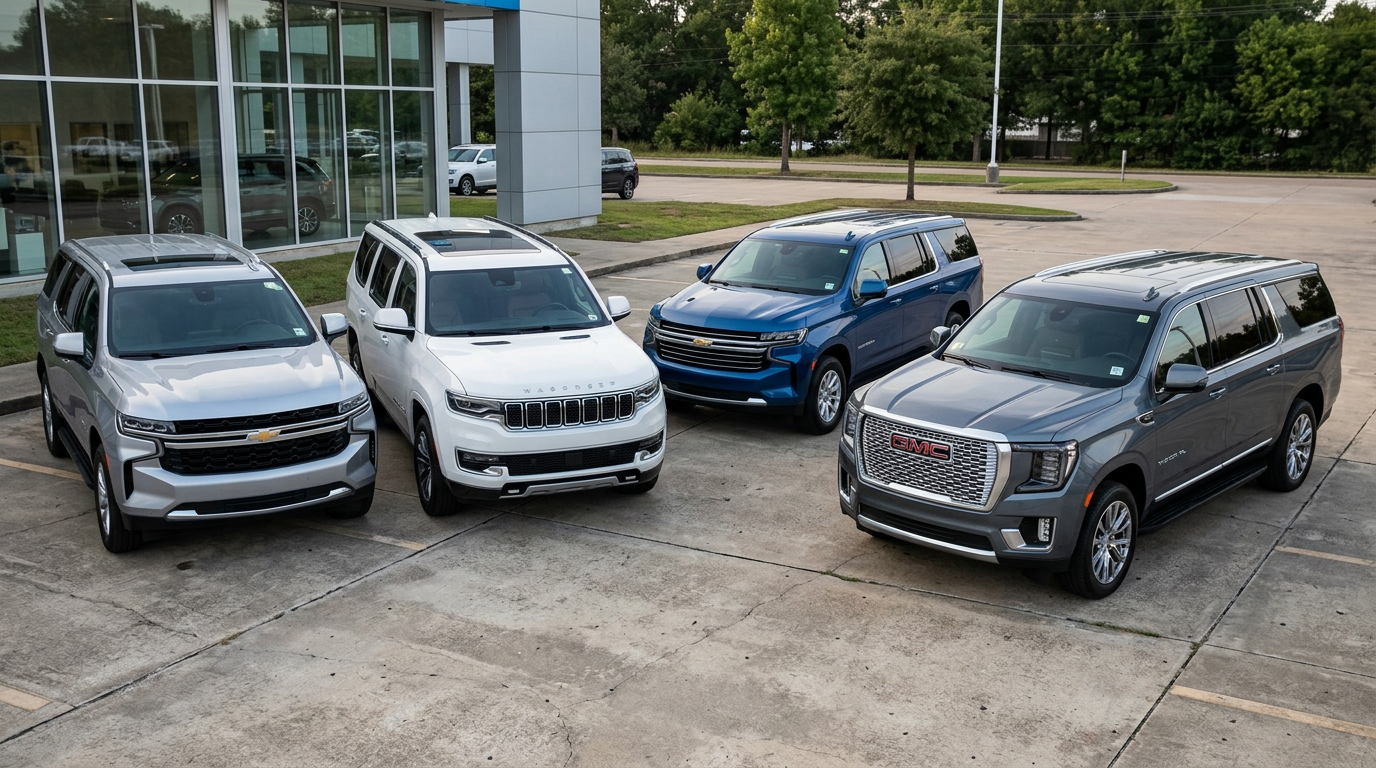
 The primary difference among full-size SUVs on our lot comes down to body length and towing capability. Standard-wheelbase models like the Chevrolet Tahoe and Jeep Wagoneer offer easier maneuverability with three rows of seating, while extended-wheelbase options like the Chevrolet Suburban and GMC Yukon XL add roughly 15 inches of length for maximum cargo capacity behind the third row. For heavy hauling, a used Jeep Wagoneer leads the segment with a maximum tow rating of up to 10,000 lbs when properly equipped.
Choosing between a standard-length and extended-body full-size SUV requires assessing how often you carry a full passenger load alongside bulkier equipment. Standard-wheelbase models provide comfortable seating for up to eight passengers while maintaining a shorter overall length that simplifies garage parking and maneuvering tight parking spaces. However, when all three rows of seats are upright, cargo space behind the rear bench can fill up quickly during family road trips.
Extended-wheelbase full-size SUVs solve cargo bottlenecks by extending the frame behind the rear axle. This added length significantly increases cargo space in the rear cargo area without compromising legroom for second- or third-row passengers. Families driving out toward the marshlands near Houma often prefer extended models like the Suburban or Yukon XL when loading up fishing equipment, ice chests, and boat gear alongside a full cabin of passengers.
At A J Dohmann CDJR, our sales team helps you evaluate our pre-owned inventory to find the vehicle length, seating configuration, and drivetrain that align with your lifestyle. You can get directions to our Berwick dealership to explore these full-size models in person, or give our team a quick call to check current availability on our lot.
Table of Contents
- What Is the Main Difference Between a Chevrolet Tahoe and a Chevrolet Suburban?
- Does the GMC Yukon XL Tow More Than the Chevy Suburban?
- Why Is a Used Jeep Wagoneer a Premium Alternative to the Tahoe or Yukon?
- Does the Duramax Diesel Engine Tow More Than the V8 in a Tahoe?
- What Maintenance Items Should You Watch For on Used GM Full-Size SUVs?
- What Documents Do You Need When Purchasing a Used Vehicle in Louisiana?
- Frequently Asked Questions About Used Full-Size SUVs
- Find Your Next Used Full-Size SUV at A J Dohmann CDJR
What Is the Main Difference Between a Chevrolet Tahoe and a Chevrolet Suburban?
The main difference between a Chevrolet Tahoe and a Chevrolet Suburban is overall vehicle length and cargo capacity behind the third row. The Suburban features a 13-inch longer wheelbase and is approximately 15 inches longer overall, expanding rear cargo volume from about 26 cubic feet in the Tahoe to roughly 42 cubic feet in the Suburban.
Both vehicles share the same frame architecture, front-end design, interior dashboards, and powertrain lineups. Standard propulsion across both models includes a 5.3L V8 producing 355 hp and 383 lb-ft of torque paired with a 10-speed automatic transmission. Optional powertrains for both models include a high-output 6.2L V8 generating 420 hp and a fuel-efficient 3.0L Duramax turbo-diesel inline-six engine.
- Chevrolet Tahoe Specs: Overall length of 210 inches, 121-inch wheelbase, max cargo volume of about 123 cubic feet with all rear seats folded, and up to 26 cubic feet of space behind the third row.
- Chevrolet Suburban Specs: Overall length of 225 inches, 134-inch wheelbase, max cargo volume of about 145 cubic feet with rear seats folded, and over 41 cubic feet of space behind the third row.
- Maneuverability Differences: The shorter length of the Tahoe creates a smaller turning radius, making it easier to park in suburban driveways and standard garages.
- Passenger Livability: Both vehicles offer identical head and shoulder room across all three rows, though the Suburban provides slightly more third-row legroom.
Choosing between these two GM full-size SUVs often comes down to how your family utilizes space behind the third row. If you regularly carry strollers, luggage, or sports gear while all three rows are occupied, the extra body length of the Suburban prevents cargo from crowding passenger space. If you plan on upgrading your current ride, you can value your trade-in online before visiting our dealership to streamline your purchase.
Does the GMC Yukon XL Tow More Than the Chevy Suburban?
The GMC Yukon XL does not have a higher maximum towing capacity than the Chevrolet Suburban, as both extended-body SUVs share identical platform engineering and engine options. When properly equipped with the available maximum trailering package and the standard 5.3L V8, both models achieve a peak tow rating between 7,800 lbs and 8,300 lbs depending on drivetrain configuration.
Because the GMC Yukon XL and Chevrolet Suburban share identical chassis layouts, suspension geometry, and transmission setups, their mechanical towing thresholds are virtually identical. The minor variations in listed towing limits between specific used models come down to individual trim equipment, 2WD versus 4WD configurations, wheel sizes, and curb weight variations rather than engine performance differences.
| Feature / Spec | Chevrolet Suburban | GMC Yukon XL |
|---|---|---|
| Standard Powertrain | 5.3L EcoTec3 V8 | 5.3L EcoTec3 V8 |
| Available Powertrains | 6.2L V8 / 3.0L Diesel | 6.2L V8 / 3.0L Diesel |
| Max Towing Capacity | Up to 8,300 lbs | Up to 8,300 lbs |
| Base Wheelbase | 134.1 inches | 134.1 inches |
| Overall Length | 225.2 inches | 225.2 inches |
While mechanical towing specs align closely, the GMC Yukon XL positions itself as a higher-end alternative with premium interior appointments and luxury appearance packages. High-tier trims like the Yukon XL Denali feature real wood interior accents, executive seating options, and an optional Air Ride Adaptive Suspension that automatically levels vehicle height when carrying heavy tongue weights.
Whether you choose a Suburban or a Yukon XL for your trailering needs, securing competitive auto financing makes the purchasing process smooth. You can submit a dealer credit application online to explore vehicle loan options before taking a test drive.
Why Is a Used Jeep Wagoneer a Premium Alternative to the Tahoe or Yukon?
A used Jeep Wagoneer serves as a compelling premium alternative to the Tahoe or Yukon by providing more standard engine power, superior third-row legroom, and higher overall towing capacity. Equipped with a standard 3.0L Hurricane twin-turbo inline-6 delivering 420 hp and 468 lb-ft of torque, the Wagoneer achieves a maximum tow rating of up to 10,000 lbs alongside nearly 37 inches of third-row legroom.
Inside the cabin, the Jeep Wagoneer elevates passenger comfort with standard leather upholstery, 12-way power-adjustable front seats, three-zone automatic climate control, and advanced digital displays. Compared to standard trims of the Tahoe or Yukon, the Wagoneer includes higher-end technology as standard equipment, including a 10.1-inch central touchscreen running Uconnect system software and available McIntosh premium audio setups.
| Feature / Spec | Jeep Wagoneer | Chevrolet Tahoe |
|---|---|---|
| Standard Horsepower | 420 hp | 355 hp |
| Standard Torque | 468 lb-ft | 383 lb-ft |
| Max Towing Capacity | 10,000 lbs | 8,400 lbs |
| Third-Row Legroom | 36.6 inches | 34.9 inches |
| Standard Cargo Volume | 27.9 cubic feet | 25.5 cubic feet |
Beyond passenger space, the Jeep Wagoneer features sophisticated 4x4 engineering designed to handle varied road surfaces and off-road terrain. Available with Quadra-Trac four-wheel-drive systems and Quadra-Lift air suspension, the Wagoneer can adjust vehicle ride height by up to 3.6 inches, allowing it to navigate shallow water or muddy back roads with ease.
If you are considering a full-size SUV, exploring our pre-owned vehicle inventory allows you to compare pre-owned Wagoneer models directly against GM competitors. For shoppers interested in brand-new options, our team can also walk you through our selection of new Jeep SUVs. Furthermore, our dedicated parts center stocks authentic Mopar accessories like heavy-duty trailer hitches and all-weather floor liners to customize your SUV.
Does the Duramax Diesel Engine Tow More Than the V8 in a Tahoe?
The 3.0L Duramax turbo-diesel inline-six engine does not tow more than the gas V8 engines in maximum weight capacity, topping out at an EPA-rated peak tow capacity of around 8,200 lbs in a Tahoe compared to 8,400 lbs for the 5.3L V8. However, the Duramax diesel generates 495 lb-ft of low-end torque at lower RPMs, delivering superior pull when launching heavy trailers and significantly better fuel efficiency under load.
Buyers comparing powertrains on our lot frequently ask whether the diesel out-tows the V8, only to find that while peak ratings are close, low-end pull feels vastly different under load. The 3.0L Duramax turbo-diesel achieves its peak torque at just 1,500 RPM, allowing the vehicle to pull heavy cargo up boat ramps or highway inclines without requiring high engine speeds. By contrast, the gas 5.3L V8 produces 383 lb-ft of torque at 4,100 RPM, which requires higher gear downshifts during heavy towing.
| Engine Spec | 3.0L Duramax Diesel | 5.3L EcoTec3 V8 |
|---|---|---|
| Horsepower | 305 hp | 355 hp |
| Peak Torque | 495 lb-ft @ 1,500 RPM | 383 lb-ft @ 4,100 RPM |
| Max Tow Rating (Tahoe) | Up to 8,200 lbs | Up to 8,400 lbs |
| Fuel Economy Profile | Superior Highway MPG | Standard Gas MPG |
For drivers who travel long highway miles pulling travel trailers or work equipment, the diesel powertrain offers extended fuel range between fill-ups. However, buyers should balance fuel economy savings against routine maintenance costs, such as periodic Diesel Exhaust Fluid (DEF) refills and specialized fuel filter replacements.
If maximum towing performance is your top priority for commercial work or heavy equipment, you might also want to examine truck capabilities. You can check our inventory of new Ram trucks to see how full-size pickup towing ratings compare to full-size passenger SUVs.
What Maintenance Items Should You Watch For on Used GM Full-Size SUVs?
Common maintenance items on used GM full-size SUVs include servicing the 10-speed automatic transmission, inspecting Active Fuel Management components, checking air suspension struts on equipped luxury trims, and replacing 4WD transfer case position sensors. Routine fluid changes and electrical system inspections prevent the most frequent ownership issues over higher mileage.
When evaluating a pre-owned Tahoe, Suburban, or Yukon XL, reviewing the vehicle history report and service records helps identify how key mechanical systems were maintained by previous owners. Pay close attention to these vital components during your inspection:
- Transmission Servicing: Fluid and filter maintenance for the 10-speed automatic transmission should be performed according to scheduled maintenance intervals to ensure smooth gear shifts under heavy acceleration.
- Fuel Management Systems: Active Fuel Management (AFM) and Dynamic Fuel Management (DFM) deactivate engine cylinders to save gas. High-mileage engines benefit from regular oil changes using synthetic fluids to keep valve lifters operating properly.
- Air Suspension Components: Luxury trims equipped with electronic air suspension should be checked for worn air bladders or leaking air lines, which can cause uneven vehicle ride height over time.
- Transfer Case Sensors: Models featuring electronic 4WD systems may occasionally experience position sensor indicator wear, triggering a service warning on the driver information display.
Commuters traveling daily across the Atchafalaya River bridge routes in Morgan City put consistent demands on suspension, brakes, and cooling systems. Ensuring these service items are addressed keeps your pre-owned SUV performing reliably for years to come.
You can use our online tool to schedule auto service with factory-trained technicians, or explore our curated selection of pre-owned SUVs for sale to find vehicles that have already undergone rigorous multi-point inspections.
What Documents Do You Need When Purchasing a Used Vehicle in Louisiana?
When purchasing a used car in Louisiana, you must present a valid driver's license, proof of current auto insurance, proof of income or pre-approval documentation, and the vehicle title or registration if trading in your current ride. Bringing these verified documents accelerates registration with the Louisiana Office of Motor Vehicles and simplifies state titling.
Having your paperwork organized before arriving at the showroom prevents unnecessary delays when finalizing your purchase. Here is the mandatory documentation checklist required by financial institutions and state titling authorities:
- Valid Driver's License: A current, government-issued driver's license matching your current physical address.
- Proof of Auto Insurance: An active insurance card or binder policy listing your name. If adding a new vehicle, contact your insurer beforehand to confirm coverage terms.
- Proof of Income: Recent pay stubs or bank statements if financing your purchase through a automotive lender.
- Trade-In Documentation: Original vehicle title (without outstanding liens) or current registration papers along with lender payoff information if an active auto loan exists.
- Proof of Residency: A recent utility bill or bank statement if your current physical address differs from your driver's license.
Our finance team works directly with state title agencies to complete registration transfer, calculate applicable sales taxes, and process license plate issuances right at our desk.
If you are ready to start shopping, check our dealership address and directions to visit us, give our representatives a phone call for immediate assistance, or browse our latest new vehicle inventory to view all our available vehicle options.
Frequently Asked Questions About Used Full-Size SUVs
Q: How does third-row legroom compare between a Jeep Wagoneer and a Chevrolet Tahoe?
The Jeep Wagoneer provides 36.6 inches of third-row legroom, compared to 34.9 inches in the standard Chevrolet Tahoe. This additional legroom makes the third row of the Wagoneer significantly more comfortable for adult passengers on extended road trips.
Q: What is the main structural advantage of extended-body SUVs like the Wagoneer L or Suburban?
Extended-body SUVs add approximately 15 inches of total vehicle length behind the rear axle. This structural design increases rear cargo volume behind the third-row seat from roughly 26 cubic feet to over 41 cubic feet without reducing passenger legroom in the front two rows.
Q: Do four-wheel-drive full-size SUVs require specialized maintenance in coastal regions?
Vehicles driven frequently near coastal marshes benefit from routine undercarriage rinses to clear away salt residue and moisture. Regularly inspecting transfer case fluids, front/rear differential lubricants, and frame anti-corrosion coatings helps maintain 4WD system durability.
Q: Can I trade in a vehicle that still has an active loan balance when buying a used SUV in Louisiana?
Yes, you can trade in a vehicle with an active auto loan. The dealership contacts your current lender to obtain an official payoff quote, applies your vehicle's appraised trade value toward the balance, and rolls any remaining equity or balance into your new vehicle purchase agreement.
Q: What safety and driver-assist features come standard on recent-model Jeep Wagoneer vehicles?
Recent Jeep Wagoneer models come standard with active lane-management systems, adaptive cruise control with stop-and-go functionality, full-speed forward collision warning with active braking, blind-spot monitoring, and rear cross-path detection.
Find Your Next Used Full-Size SUV at A J Dohmann CDJR
Whether you need the maximum cargo space of an extended Suburban, the luxury towing capability of a Jeep Wagoneer, or the overall utility of a Tahoe or Yukon XL, our pre-owned lot features a wide variety of full-size SUVs ready for your family. Visit A J Dohmann CDJR at 802 Robison Dr, Berwick, LA 70342 to test drive your preferred SUV configuration, inspect interior seating layouts, and speak with our dedicated automotive team today.
© 2026 A J Dohmann CDJR. All rights reserved.